
FACA LÍQUIDA
LIQUID KNIFE
Paisaje sonoro e instrumentos de cerámica.
Residencia Binaural Nodar,
2024, Vársea de Calde, Portugal.
Soundscape and ceramic instruments
Binaural Nodar residency
2024, Vársea de Calde, Portugal.
•
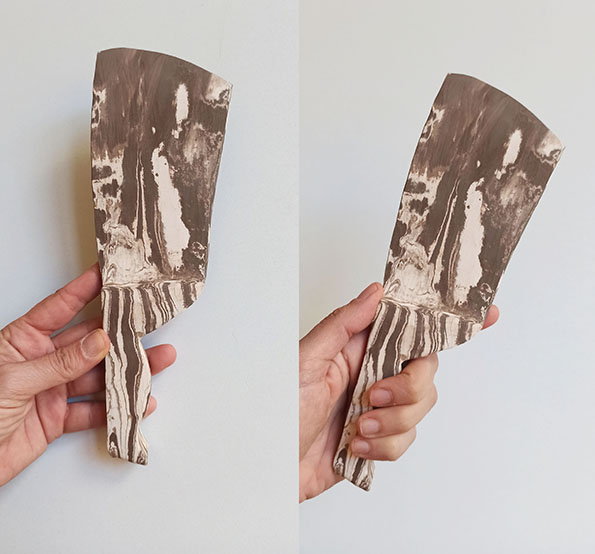
Espadela de cerámica
Ceramic scutcher
Ceramic scutcher

FACA LÍQUIDA es una pieza sonora y una serie de objetos. Explora la relación entre el agua y el cuerpo, ensaya juegos con distintas herramientas y artefactos. Un homenaje al trabajo manual que explora el ritmo como testimonio sonoro de la iteración de acciones, y a los ciclos que permiten asentarse en un lugar y tejer lazos. ¿Cómo moldea el agua a las comunidades que genera? En la Várzea actual y en su archivo sensorial, suena al correr por manantiales y tubos, al chocar contra vasijas de lata en filas en torno a las fuentes, en los fardos de lino azotados contra las piedras en remojo, en las corrientes que empujan molinos y acompañan círculos de mujeres que machacan fibras al ritmo de una canción. Algunas personas del lugar me contaron sus historias de agua y ritmo, y este es también un homenaje a esos relatos. Memorias del agua en el cuerpo, del cuerpo en movimiento y de los objetos que usamos para interactuar con nuestro mundo.
FACA LÍQUIDA is a soundscape and a series of objects. It explores the relationship between water and the body, testing play with different tools and artifacts. An homage to manual labor that explores rhythm as an audible testimony to the iteration of actions, and to the cycles that make it possible to settle in a place and weave connections. How does water shape the communities it generates? In present day Várzea and its sensory archive, we hear it flowing through springs and pipes, striking tin vessels queued around fountains, in the bundles of flax bashed against soaking stones, in the currents that drive mills and accompany circles of women pounding fibers to the rhythm of a song. Some locals shared their stories of water and rhythm with me, and this is also an homage those tales. Memories of water in the body, of the body in motion, and of the objects we use to interact with our world.

Presentación en vivo en la vera del río Vouga.
Set electroacústico con grabaciones de campo, ocarinas, vasos silbadores e instrumentos de percusión.
Live performance by the Vouga riverbank.
Electroacustic set with field recordings, ocarinas, whistling vessels, and percussion instruments.
Binaural Nodar es un proyecto cultural que opera en la región portuguesa de Viseu Dão Lafões, en las áreas de arte sonoro, documentación, educación y radio. El cantar de las fuentes fue una convocatoria para trabajar con el agua en el pueblo de Várzea de Calde, una comunidad muy pequeña rodeada de manantiales y dedicada principalmente al cultivo y producción de lino a muy pequeña escala y utilizando herramientas tradicionales. Al año siguiente, en 2025, volví a la región junto a Binaural en una segunda residencia, esta vez en Ribolhos para realizar un proyecto en torno a la práctica del barro negro. Esa exploración dio lugar a Dreamtigers. Ambas piezas son gemelas extrañas: siendo la segunda un reflejo especular de la primera, sus derivas sonoras están unidas ahora en un díptico bajo el nombre de Faca Líquida, donde la primera obra actúa como origen y la segunda como su eco.
Binaural Nodar is a cultural project operating in the Portuguese region of Viseu Dão Lafões, working within the fields of sound art, documentation, education, and radio. The Singing of Springs was an open call to work with water in the village of Várzea de Calde, a very small community surrounded by springs and mainly dedicated to the cultivation and production of linen on a small scale using traditional tools. The following year, in 2025, I returned to the region alongside Binaural for a second residency, this time in Ribolhos, to develop a project centered around the practice of black pottery. That exploration became Dreamtigers. Both pieces are strange twins: with the second being a specular reflection of the first, their sonic drifts are now united in a diptych under the name Faca Líquida, where the first work acts as the origin and the second as its echo.